
Product overview
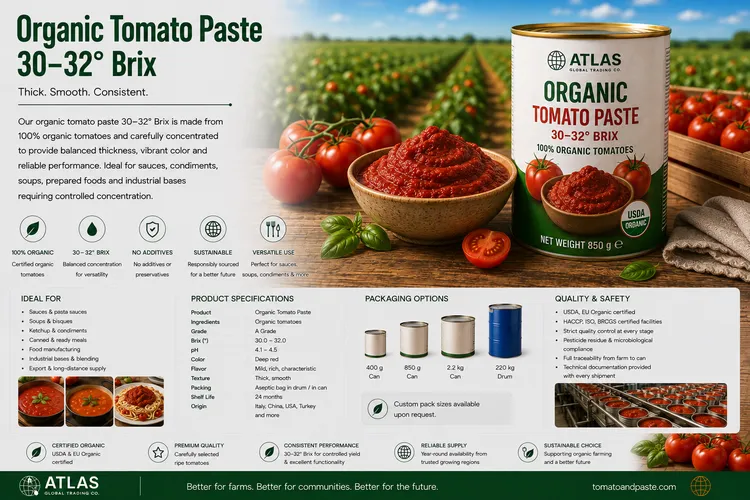
Organic tomato paste at 30–32° Brix is a concentrated tomato ingredient produced from certified-organic tomatoes for industrial food manufacturing. The specified concentration range can be useful where buyers want more tomato solids than a lower-concentration product while avoiding the handling characteristics of very high-solids paste.
It can serve as a concentrated base for sauces, condiments, soups, prepared foods and industrial tomato systems. Manufacturers can adjust water and other recipe components to achieve their required finished solids, viscosity, flavor and process characteristics.
Atlas Global Trading Co. sources tomato ingredients through a multi-origin network of farms, processors and supply partners. We match the ingredient to the customer’s target Brix, consistency, organic certification requirements, commercial pack format, technical documentation, destination and supply program.
Specification focus
The 30–32° Brix concentration should be treated as a defined purchasing parameter within the full product specification. Buyers should confirm the contractual soluble-solids range, test method and acceptable lot variation with the selected processor.
Process style can also influence finished performance. Depending on the processor and program, hot-break or cold-break characteristics may be relevant to viscosity, tomato flavor, color and the way the paste behaves after dilution. The actual process should be confirmed rather than assumed from Brix alone.
Consistency or viscosity is another important control point because two pastes with similar soluble solids may behave differently during pumping, mixing, heating and filling. Buyers should identify the consistency method and target range that best reflects their plant and finished product.
Color, pH, acidity, finish and microbiological limits may also be included in the approved specification. These parameters should be aligned with the intended formulation, thermal process, sensory target and customer- specific quality requirements.
Formulation yield and dilution
A controlled 30–32° Brix range can support predictable formulation yield because the incoming concentration is more tightly defined. This can simplify water calculations and help reduce batch-to-batch variation when the paste is used as a primary tomato-solids source.
Reconstitution ratios should be calculated from the actual approved specification rather than from the product name alone. Small changes in incoming solids can influence finished Brix, viscosity and total recipe yield in large industrial batches.
When replacing a different paste concentration, manufacturers should recalculate both paste and water additions and confirm the final texture, color and flavor through plant or pilot trials.
Balance of concentration and handling
Compared with lower-solids paste, a 30–32° Brix product can deliver more tomato solids per unit of weight and reduce the amount of water moved through the supply chain. At the same time, it may be easier for some plants to handle than more highly concentrated paste, depending on consistency and temperature.
The best concentration therefore depends on the complete manufacturing system rather than Brix alone. Freight, storage, unloading, pumping, dilution, recipe design and finished-product requirements should all be considered when selecting the most economical format.
Aseptic supply and plant handling
Organic tomato paste in this concentration range may be available in aseptic industrial formats, subject to processor capability. Aseptic bulk supply can support large-scale manufacturing by combining concentrated tomato solids with commercially practical storage and transport.
Plant teams should confirm compatibility with unloading equipment, pumps, piping and mixing systems. Paste consistency, product temperature, liner configuration and transfer method can all influence emptying and processing efficiency.
Storage and handling conditions should follow the current processor specification. Production trials can be useful when qualifying a new source or changing from another concentration or process style.
Typical applications
- Tomato and culinary sauces
- Ketchup, condiments and dipping systems
- Soups and concentrated soup bases
- Ready meals and prepared foods
- Industrial tomato bases and blending
- Organic private-label manufacturing programs
Packaging and logistics
Industrial supply may include aseptic drums, larger bulk containers or other processor-approved configurations. Exact pack size, liner, palletization, shelf life and storage conditions are confirmed with the selected commercial program.
Buyers should consider not only price per tonne but also delivered tomato-solids cost, freight utilization, storage footprint and plant handling. Destination, shipment size and annual volume may affect the most practical origin and packaging option.
Organic program controls
Organic certification is a core part of the product specification. We confirm certification scope and supporting records for the selected processor, origin and supply lot, including relevant chain-of-custody documentation where applicable.
Buyers should provide the destination country and any customer-specific organic requirements during inquiry because accepted certification and labeling pathways can vary by market.
Final organic claims should remain aligned with the approved ingredient, processor certification, supply documentation and destination-market requirements.